Sustainability for Vitec

Sustainability is a central part of Vitec’s success and permeates its operations from ecological, social and economic perspectives. The products contribute to positive societal impacts and reduced risk while promoting responsible business practices that allow employees’ expertise and creativity to flourish. Vitec takes an entrepreneurial approach to sustainability and aims to enable solutions for today’s needs without compromising the opportunities for future generations.

How we work with sustainability

At an overall level, Vitec’s strategy is based on its values and brand promise “To rely on – today and tomorrow.” The company’s business concept is to contribute to the success of its customers by developing and providing standardized and niche business-critical software.

Alongside the efforts of management and the Board, sustainability initiatives are implemented within the business units. Sustainability is integrated into the directives issued annually to each business unit, while the units also embed sustainability into their strategic planning. In the company’s decentralized business model, most sustainability impacts arise within the
business units.

From the business units’ perspective, sustainability plays an important role in product development. Customers demand software that contributes both to energy efficiency and to other, more sustainable solutions. The product planning process is carried out as part of the business units’ strategic planning, where challenges and opportunities are identified.

Sustainability strategy

Integrated into the business ↓

  • Sustainability is part of the business model
  • Guided by values and the brand promise
  • Focus on customer value through mission-critical software

Structured and continuous work ↓

  • Annual cycle: follow-up, stakeholder dialogue, double materiality
  • Targets set by Group Management and Board
  • Execution primarily in decentralized business units

Business-integrated sustainability ↓

  • Integrated in product development and strategy
  • Supports more energy-efficient and sustainable customer solutions

Sustainable business model and focus areas

To structure this effort and clarify its direction, Vitec has defined four focus areas: Reduced footprint, Empowered people, Enabling products, and Responsible growth. They are specified based on where and how the business has the greatest impact on its external environment, as well as areas where Vitec believes it can make the greatest difference.

Vitec’s value chain

This model illustrates where Vitec’s material impacts, risks, and opportunities (IROs) arise within the company’s direct and indirect business relationships across the entire value chain: upstream, own operations, and downstream, including the company’s stakeholders.

Upstream value chain

Vitec’s upstream value chain consists of suppliers and subcontractors. Examples of such actors include suppliers of IT equipment and providers of computer operations. These actors, in turn, have subcontractors that supply and manufacture the equipment. There are participants in the value chain that extract sensitive minerals from mines, as well as those that manage transportation. The value chain also encompasses the individuals who work for these subcontractors.

Other suppliers include landlords for our premises and subcontractors working with software development.

Own Operations

Vitec's talented employees are an extremely important component of its value-generation strategy.

The long-term perspective is also central to the organization’s aspiration to promote sustainable employeeship, providing employees with an opportunity to use their energy wisely, to grow and to maintain balance in life. Each employee is entrusted with great responsibility to contribute their specific expertise in the organization’s ongoing development efforts.

Vitec’s own employees are the most important resource, and equal treatment and fair working conditions are fundamental principles.

Downstream value chain

Vitec’s customers – along with their own customers – comprise the downstream segment of the value chain. The Group’s business units develop and deliver standardized software that supports customers’ operations.

Customers use the software in their interactions with their own customers and end consumers.

Although downstream activities may involve certain risks, they are dominated by opportunities created through Vitec’s products – such as increased efficiency in work processes, improved energy efficiency, reduced waste and enhanced sustainability reporting.

For consumers and end-users, information security and data protection are top priorities.

Sustainability ​goals

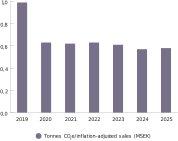
Climate impact


Goal: Continuously decreasing

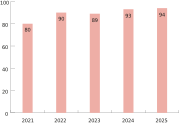
Information security training completeness

Goal: 100%

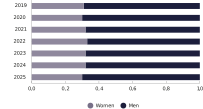
Gender distribution


Goal: 40/60